Scale range
Range of measured values (smallest up to largest measurable value) that a photometer can cover. In most cases it is divided into measuring ranges.
Scatter losses
In addition to the absorption of radiation when traversing an optical medium, such as glass, scatter (scattered light) can also cause an intensity reduction of the transmitted radiation.
Scattered light
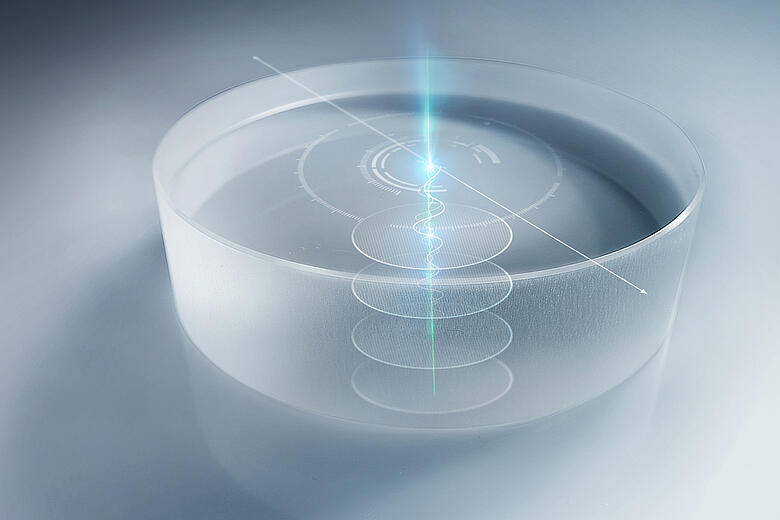
In an optically homogeneous medium, the light progresses in a straight line. Any change of the optical properties by an obstacle will deflect the ray of light from its path. This physical process is called scattering of light by particles. Light scattering is the cause for turbidity.
Scattered light
In an optically homogeneous medium, the light progresses in a straight line. Any change of the optical properties by an obstacle will deflect the ray of light from its path. This physical process is called scattering of light by particles. Light scattering is the cause for turbidity.
Scattered light measurements, cells for
Usually, these
are cylindrical cells that have to meet high requirements
as regards the existence of scratches, bubbles,
and striae.
Scattered light measurements, cells for
Usually, these are cylindrical cells that have to meet high requirements as regards the existence of scratches, bubbles, and striae.
Semi-Micro cell
Either a rectangular cell with an inside width of 2 to 5 mm or a cylindrical cell with a diameter of 5 to 8 mm.
Single-beam method
Photometric concept in which only one light source and only one detector is used ( dual-beam method, photometer).
Solarisation
mainly is the designation for the permanent or sometimes also the reversible discolouration of certain glasses under the influence of radiation with a high UV percentage. This discolouration is combined with a reduction of the transmission in the transmission range.
Solarisation
mainly is the designation for the permanent or sometimes also the reversible discolouration of certain glasses under the influence of radiation with a high UV percentage. This discolouration is combined with a reduction of the transmission in the transmission range.
Spectral reflectance
The spectral reflectance is the ratio of the reflected radiant flux to the incident radiant flux at a certain wavelength.
Spectrally measured
On request, cells can be put together in a set in which all cells, measured while empty, show the same transmittance value measured at a certain ? wavelength. Because of the validity of Lambert- Beer's law, the light paths of sets of cells with small light paths (below 1 mm) should be as similar as possible.
Spectrum
Distribution of the intensity of electromagnetic radiation as a function of wavelength. The interesting range for industrial photometry comprises the light waves, i.e. the visible, the ultraviolet, and the infrared light. Spectra produced by prisms or gratings make the spectral colours of the used light visible, starting from shortwave violet and on through blue, green, yellow and orange to long-wave red.
Stray light (extraneous light)
is the light in a photometer striking the receiver and producing a measuring signal without traversing the sample. Sometimes, a distinction is made between stray light which e.g. traversed the thick lateral walls of a semi-micro cell and extraneous light which originates from an external light source and often reaches the receiver by means of reflection at the walls. Both terms are also often summarised under the designation scattered light.
Stray light (extraneous light)
is the light in a photometer striking the receiver and producing a measuring signal without traversing the sample. Sometimes, a distinction is made between stray light which e.g. traversed the thick lateral walls of a semi-micro cell and extraneous light which originates from an external light source and often reaches the receiver by means of reflection at the walls. Both terms are also often summarised under the designation scattered light.
Striae
are in most cases threadlike defects in the glass that are apparent because of their different refractive index.
SUPRASIL
is a synthetic quartz glass manufactured by Heraeus Quarzglas GmbH.
Surface defects
Scratches and holes as well as nonpolished spots on the glass surface.